 comparison
Managed IT Services vs Break-Fix: 2026 Comparison
Table of Contents
- Managed IT Services vs Break-Fix: Core Differences
- Proactive vs Reactive IT Support: How They Protect Your Business
- Hidden Costs of Break-Fix IT You Need to Know
- Managed Services Pricing Models Explained
- Risk Management and Business Continuity
- Scalability and IT Infrastructure Growth
- Transition Roadmap: Moving from Break-Fix to Managed Services
- Conclusion
Last Updated: August 9, 2026
Managed IT Services vs Break-Fix: Core Differences
Managed IT services and break-fix IT support represent two fundamentally different approaches to keeping your business running. Break-fix works like calling a plumber only after your pipes burst: you pay per incident for a technician to diagnose and fix problems after they occur. Managed IT services work oppositely, a dedicated team monitors your entire infrastructure 24/7, patches systems before vulnerabilities become exploitable, and prevents most problems from happening in the first place.
The financial difference is stark. Break-fix creates unpredictable expenses that spike when you can least afford them. Managed services flatten IT costs into a predictable monthly fee. More importantly, managed services eliminate the downtime that breaks companies.
VegaMSP delivers a comprehensive managed IT services approach through their "Secure-IT-In-The-Box" model, combining fully managed network services, endpoint security, and unlimited helpdesk support. This contrasts sharply with break-fix vendors who only engage when you call them in crisis mode. Businesses on managed services experience significantly fewer unplanned outages and maintain better security postures than those relying on break-fix support alone.
Proactive vs Reactive IT Support: How They Protect Your Business
Proactive IT support identifies and fixes problems before they impact your business. Reactive IT support responds after something breaks and users are already experiencing downtime.
Proactive monitoring means your IT team watches for warning signs continuously. They see a server running at 85% capacity and upgrade it before it crashes. They identify critical security patches and deploy them before attackers exploit vulnerabilities. They notice unusual network traffic and investigate potential threats before data is compromised.
Reactive support means you call when something stops working. Your email server goes down, users can't access their inboxes, customers can't reach you, and revenue stops flowing. Then you wait for a technician to become available, diagnose the problem, and fix it.
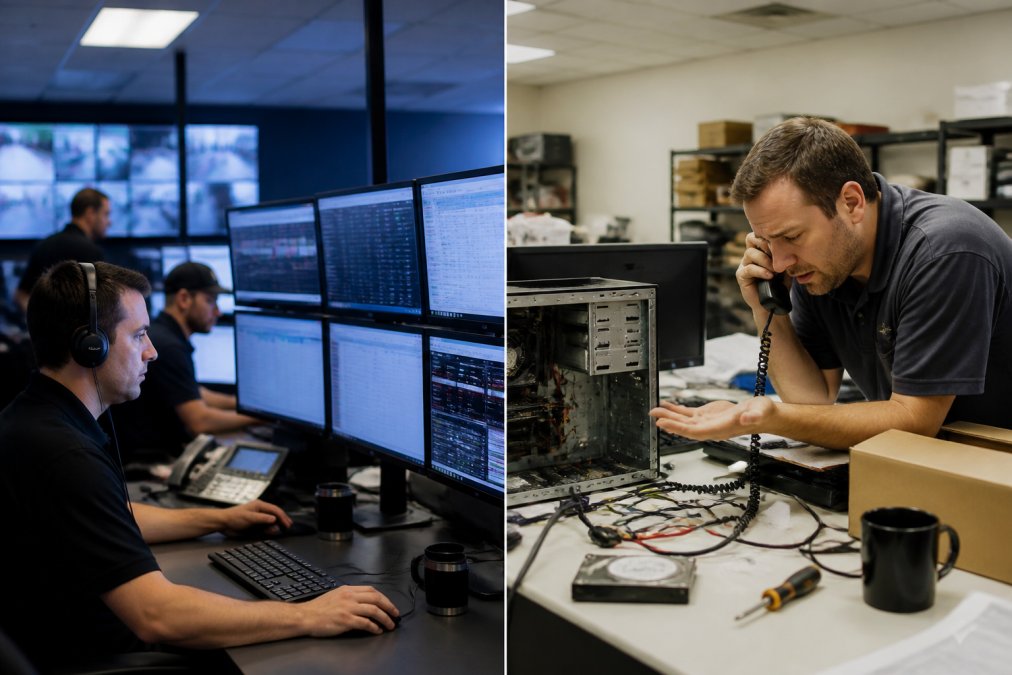
Proactive teams spend time optimizing systems and planning infrastructure improvements. Reactive teams spend time fighting fires. One builds resilience; the other manages chaos.
Security outcomes differ dramatically. Proactive monitoring catches intrusion attempts in progress. Reactive approaches discover breaches weeks or months after the fact, when attackers have already exfiltrated data. Compliance violations, customer notification requirements, and regulatory fines follow. The cost of a single data breach often exceeds years of preventive security investment.
Availability is where the business impact becomes undeniable. A manufacturing company relying on break-fix support experiences unexpected downtime that halts production. A professional services firm loses billable hours when systems are offline. A retail operation loses sales when point-of-sale systems fail. Managed services keep systems running continuously through proactive monitoring and rapid response.
Hidden Costs of Break-Fix IT You Need to Know
Break-fix pricing appears cheaper initially because you only pay when you need service. The true cost emerges over time through multiple channels that managed services eliminate.
Unplanned downtime costs more than the service call. When your system fails, your team can't work. If you're a software company, that's lost development time. If you're a service provider, that's unbillable hours. If you're a retailer, that's lost sales. The IT vendor's hourly rate is trivial compared to your business's cost per hour of downtime. The average cost of IT downtime for small and mid-sized businesses (SMBs) in 2026 ranges from $5,000 to $50,000 per hour, depending on company size, industry, and reliance on technology. For a 50-employee company, even a a 2-hour outage can cost $10,000-$100,000 in lost productivity, revenue, and recovery expenses. A 4-hour outage costs far more than a month of managed services.
Escalation fees compound quickly. Break-fix vendors charge for diagnosis, the fix itself, after-hours emergency response, and travel time. Multiply that across multiple incidents per year, and your "pay-as-you-go" model becomes expensive fast.
Security incidents triggered by neglected systems are catastrophically expensive. Break-fix models create a gap where systems don't get patched until something fails. That window is where attackers operate. A ransomware infection that encrypts your entire network and forces shutdown costs orders of magnitude more than proactive endpoint security and patch management. The average cost of a data breach for small businesses is approximately $1.6 million, with some estimates as high as $3.31 million for firms under 500 employees. Other sources estimate the average cost of a cyberattack targeting an SMB at approximately $254,000. The cost of addressing a security incident can include direct financial damages, employee hours spent resolving the breach, hiring incident response firms, loss of revenue, higher insurance premiums, and penalties for non-compliance.
Staff productivity suffers during outages. When your network goes down, employees sit idle. Break-fix support doesn't prevent these gaps; it only addresses them after they happen. Managed services prevent most outages before they start.
Technical debt accumulates silently. Break-fix environments rarely get planned upgrades or architectural improvements. Systems age in place, performance degrades, and security vulnerabilities accumulate. Eventually, a major failure forces an emergency overhaul that costs far more than incremental, planned improvements.
Managed Services Pricing Models Explained
Managed IT services typically use fixed monthly pricing based on the scope of services and number of users or devices managed. This is fundamentally different from break-fix's hourly or per-incident model.
Most managed services providers structure pricing around "per-user" or "per-device" tiers. A small business with 15 employees might pay a flat monthly fee covering network monitoring, endpoint security, patch management, and helpdesk support for all devices. As the business grows to 25 employees, the monthly fee increases proportionally, but the cost per employee decreases.
The fixed-fee model eliminates cost surprises. You're not charged extra for after-hours support, emergency response, or critical vulnerability patching, it's all included. Your IT budget becomes a predictable line item you can forecast and plan around.
Some managed services providers offer tiered service levels. A "basic" tier might include network monitoring and patch management. A "premium" tier adds advanced threat detection and compliance reporting. A "comprehensive" tier includes everything plus VoIP management and cloud infrastructure support.
VegaMSP's approach includes fully managed network services, endpoint security, VoIP integration, and unlimited helpdesk support within their model, allowing businesses to consolidate multiple vendor relationships into a single, predictable monthly cost. This contrasts with break-fix environments where you might pay different vendors for server support, network issues, security, and helpdesk, each with unpredictable costs.
Fixed pricing enables better budget forecasting and allows you to allocate resources to growth initiatives instead of bracing for the next emergency.
Risk Management and Business Continuity
Break-fix IT is fundamentally incompatible with business continuity planning. You can't guarantee uptime if you're waiting for a technician to respond to problems after they occur.
Managed services include proactive disaster recovery planning. Your team identifies critical systems, determines acceptable recovery time objectives (RTO) and recovery point objectives (RPO), and implements automated backups and failover systems. If your primary server fails, traffic automatically routes to a secondary system. If data is corrupted, automated backups allow recovery to a known-good state.
Break-fix environments lack this planning. You have backups only if you remembered to implement them. You have redundancy only if you paid extra for it. When disaster strikes, you're improvising under pressure.
Cybersecurity risk differs fundamentally between the two models. Managed services include continuous monitoring for intrusion attempts, malware infections, and suspicious behavior. Security patches are deployed within days of release, not weeks or months later. Endpoint detection and response systems identify threats in progress and contain them before they spread.
Break-fix environments leave security gaps. Systems run unpatched for extended periods. Intrusions go undetected until damage is discovered. The cost of addressing a security incident discovered months after it occurred, including forensic investigation, customer notification, and regulatory fines, dwarfs the cost of preventive security.
Regulatory compliance is another risk dimension. Healthcare providers, financial institutions, and government contractors face specific compliance requirements. Managed services providers maintain the monitoring, documentation, and incident response capabilities required for compliance. Break-fix support doesn't.
Scalability and IT Infrastructure Growth
Break-fix IT creates a scalability problem: as your business grows, your IT complexity grows faster than your ability to manage it reactively.
A 15-person startup can survive with break-fix support because systems are simple and failures are infrequent. A 50-person company has more systems, more users, more integrations, and more dependencies. The probability of failure increases. A 150-person organization has evolved into a complex infrastructure where reactive support is practically impossible.
Managed services scale with your business. Your managed services provider adds monitoring for new systems as you implement them. They adjust security policies as your data sensitivity changes. They optimize infrastructure as your usage patterns evolve. The provider's team grows with your needs, but the cost per user typically decreases as you scale.
VegaMSP's fully managed approach means your IT infrastructure grows strategically rather than organically. New network segments are designed and secured from the start. New endpoints are provisioned with security policies already in place. New applications are integrated into your monitoring and backup systems automatically.
Break-fix environments create technical debt as they scale. You add systems without integrating them into a cohesive architecture. You patch some systems but not others. You back up some data but not all. Eventually, the accumulated complexity becomes unmaintainable.
Transition Roadmap: Moving from Break-Fix to Managed Services
Moving from break-fix to managed services requires planning to avoid disruption. The transition is a staged process that runs in parallel with your existing support.
Phase 1: Assessment and Planning (Week 1-2)
Document your current IT environment comprehensively. Inventory all systems, applications, data locations, users, and integrations. Identify critical systems where downtime is unacceptable. Determine your security and compliance requirements. This assessment informs the managed services design and prevents surprises during implementation.
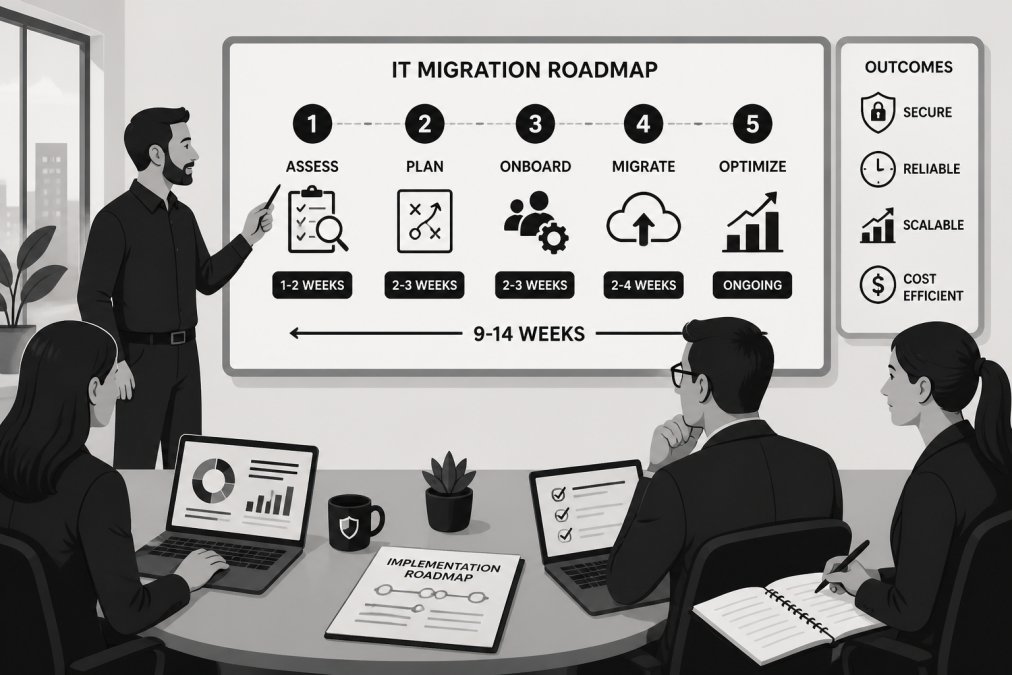
Phase 2: Design and Planning (Week 2-4)
Work with your managed services provider to design the target infrastructure. Define monitoring scope, backup strategy, security policies, and incident response procedures. Create a detailed implementation timeline. Identify systems that require staged migration versus systems that can migrate simultaneously.
Phase 3: Parallel Running (Week 4-12)
Implement managed services components while maintaining break-fix support. Start with non-critical systems to validate processes. Gradually migrate critical systems as confidence increases. During parallel running, both old and new systems are active, allowing rollback if issues arise.
Phase 4: Cutover and Validation (Week 12-16)
Migrate remaining systems to fully managed services. Validate that all monitoring is functioning, backups are occurring, and security policies are enforced. Conduct thorough testing of failover and disaster recovery procedures.
Phase 5: Optimization (Ongoing)
After transition, the managed services provider optimizes infrastructure based on actual usage patterns. They fine-tune monitoring thresholds, adjust backup schedules, and identify efficiency improvements.
A critical success factor is communication. Your team needs to understand the new support model, new processes for requesting IT services, and new ways to report issues. The managed services provider should provide documentation and support during this learning period.
The transition typically takes 8-16 weeks depending on infrastructure complexity. During this time, you're paying for both break-fix support (which continues until fully migrated) and managed services (which is ramping up). This overlap is an additional cost, but it's far smaller than the cost of a failed migration that causes extended downtime.
The choice between managed IT services and break-fix support is fundamentally a choice between predictability and crisis management. Break-fix IT is reactive, you pay only when something breaks, but you pay in downtime, emergency fees, and security risks. Managed IT services is proactive, you pay a predictable monthly fee and gain continuous monitoring, rapid response, and the ability to focus on your core business instead of fighting IT fires.
For businesses scaling beyond 20-30 employees, break-fix support becomes increasingly untenable. The complexity of your infrastructure, the cost of downtime, and the security risks all favor managed services. VegaMSP's comprehensive approach, combining fully managed network services, endpoint security, VoIP integration, and unlimited helpdesk support, eliminates the need to juggle multiple vendors and unpredictable costs. Get started with VegaMSP and transform your IT infrastructure from a source of stress into a competitive advantage that scales with your business.
Frequently Asked Questions
What is the main difference between break-fix and managed IT services?
Break-fix IT responds to problems after they occur, charging per incident or hourly. Managed IT services provide proactive monitoring, maintenance, and support on a flat monthly fee. Break-fix creates unpredictable costs and downtime; managed services deliver predictable budgets and prevent issues before they impact operations. For growing businesses, managed services eliminate the reactive cycle that slows productivity.
Is managed IT services more cost-effective than break-fix?
For most businesses beyond 10-15 employees, managed IT services cost less over time despite higher monthly fees. Break-fix appears cheaper initially but hidden costs add up: emergency after-hours charges, extended downtime, lost productivity, and unplanned hardware replacement. Managed services include proactive monitoring, patch management, and incident response in one predictable fee, reducing total cost of ownership significantly.
What are the risks of using a break-fix IT model?
Break-fix IT carries substantial operational and financial risks. Systems fail without warning, causing downtime that stops revenue and damages customer trust. Security gaps widen because monitoring is reactive, not preventive. Costs spike unpredictably when multiple issues hit simultaneously. Compliance risks increase without continuous patch management and audit trails. For scaling businesses, break-fix creates technical debt that becomes expensive to resolve later.
When should a business switch from break-fix to managed services?
Switch when downtime costs more than managed services fees, when IT issues disrupt core operations regularly, or when your team lacks time for strategic planning. Businesses with 15+ employees, multiple locations, or heavy reliance on cloud systems benefit immediately. If you're hiring IT staff or facing compliance requirements, managed services delivers better security and control. The transition works best before scaling, not after crisis forces the move.
Does break-fix IT include proactive security monitoring?
No. Break-fix IT is inherently reactive, technicians respond to reported problems. Proactive security monitoring, patch management, threat detection, and vulnerability scanning require continuous oversight that break-fix doesn't provide. This gap leaves businesses exposed to breaches, ransomware, and compliance violations. Managed IT services include remote monitoring and management tools that detect threats and patch systems automatically, protecting your infrastructure 24/7 without waiting for issues to surface.
This article was written using GrandRanker