 listicle
Managed VoIP Services for Business: Top 10 Picks (2026)
Table of Contents
- How We Evaluated Managed VoIP Services for Business
- Quick Comparison: Top Managed VoIP Services at a Glance
- 1. VegaMSP: Fully Managed VoIP With Endpoint Security Built In
- 2. RingCentral MVP: Unified Communications for Scaling Teams
- 3. Nextiva: Affordable Entry Point for Small Business VoIP
- 4. 8x8 X Series: UCaaS With International Calling Included
- 5. Dialpad: AI-Powered Call Analytics and Real-Time Transcription
- 6. Vonage Business Communications: API-First Flexibility
- Managed VoIP vs. Hosted VoIP: Understanding the Real Difference
- VoIP Security Best Practices and Compliance Considerations
- Number Porting and Migration: What to Expect When You Switch
- Business VoIP Pricing Models: Total Cost of Ownership Analysis
- Scalability and Integration: What Growing Teams Need to Verify
- Frequently Asked Questions
Last Updated: August 4, 2026
Switching your business phone infrastructure is one of the most consequential IT decisions a growing company can make. Managed voip services for business have evolved far beyond simple call routing: today's solutions bundle unified communications, endpoint security, call analytics, and business continuity into a single managed platform. At VegaMSP, we work with SMBs ranging from 10 to 250 employees every day, and the question we hear most often is not "which VoIP provider has the best features?" but "which solution will actually stay managed, secure, and reliable once we sign the contract?"
Below, we rank the top picks for 2026, explain what separates a truly managed solution from a self-serve cloud phone system, and give you the migration and TCO context that most guides skip entirely.
Quick Picks:
- Best Overall (Fully Managed): VegaMSP - ideal for SMBs that need VoIP integrated with endpoint security and unlimited helpdesk support
- Best Standalone UCaaS: RingCentral MVP - strongest feature set for scaling teams
- Best Budget Entry: Nextiva - lowest barrier to entry for small teams
- Best for AI Features: Dialpad - real-time transcription and call analytics built in
- Best for International Calling: 8x8 X Series - international calling included at base tier
How We Evaluated Managed VoIP Services for Business
Selecting the right managed VoIP services requires a framework that goes beyond feature checklists. Our evaluation covered six dimensions: call quality reliability, security architecture, integration depth, scalability mechanics, total cost of ownership, and the actual level of management the vendor provides post-deployment.
The distinction between "managed" and "hosted" matters more than most buyers realize. Hosted VoIP means the provider runs the cloud infrastructure, but your team still configures, monitors, and troubleshoots the system. Managed VoIP services for business means the vendor takes ongoing operational responsibility: monitoring call quality metrics like latency, jitter, and packet loss; managing firmware updates on desk phones and softphones; and providing a defined service level agreement with response time guarantees.
We also weighted compliance readiness for healthcare, finance, and legal services, which face specific regulatory obligations around call recording, data retention, and end-to-end encryption.
| Evaluation Dimension | What We Measured |
|---|---|
| Call Quality | Latency targets, jitter tolerance, packet loss thresholds |
| Security | End-to-end encryption, endpoint protection, compliance certifications |
| Integration | CRM, helpdesk, Microsoft 365, Google Workspace connectivity |
| Scalability | User scaling mechanics, number porting process, multi-site support |
| TCO | Per-user costs, hidden fees, hardware, porting, and migration costs |
| Support Level | Response time SLAs, proactive monitoring, helpdesk depth |
According to FCC guidance on VoIP services and regulatory requirements, VoIP providers operating in the US carry specific obligations around E911 compliance and CPNI protections that buyers should verify before signing any contract.
Quick Comparison: Top Managed VoIP Services at a Glance
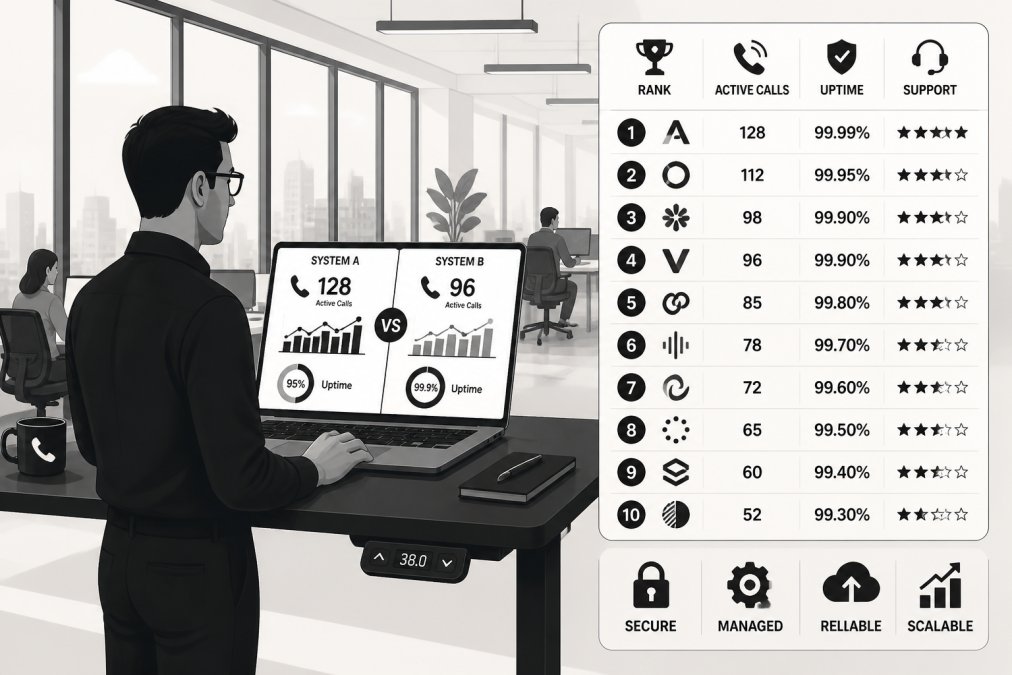
Here is where the market stands at a glance. Pricing shown reflects publicly available data from vendor websites as of mid-2026. VegaMSP pricing is customized per deployment; contact the team directly for a quote.
| Provider | Starting Price | Free Tier | Best For | Standout Feature |
|---|---|---|---|---|
| VegaMSP | Custom quote | No | SMBs needing fully managed VoIP + security | Secure-IT-In-The-Box with endpoint protection |
| RingCentral MVP | $20/user/mo | No | Scaling teams, UCaaS depth | Unified messaging, video, phone |
| Nextiva | $15/user/mo | No | Small teams, budget entry | 24/7 support, affordable core plan |
| 8x8 X Series | ~$24/user/mo | No | International calling needs | Unlimited calls to 14 countries |
| Dialpad | $15/user/mo | Yes (trial) | AI-driven analytics teams | Real-time transcription, AI noise cancellation |
| Vonage Business | $19.99/user/mo | Yes | API-first customization | Strong API extensibility |
Factor in number porting fees, SIP trunking configuration, hardware for desk phones, and any add-ons before comparing total spend.
1. VegaMSP: Fully Managed VoIP With Endpoint Security Built In
Most VoIP providers hand you a cloud phone system and walk away. VegaMSP takes a fundamentally different position: managed voip services for business should never exist in isolation from the network and endpoint security layer that surrounds them.
The VegaMSP "Secure-IT-In-The-Box" model bundles fully managed network services, VoIP integration, and endpoint security into a single managed engagement. For a 15-person team or a 200-person organization, one vendor owns the entire stack: call routing configuration, firewall protecting SIP traffic, softphone deployments, and unlimited helpdesk support.
What makes this different from a standalone VoIP subscription:
- Endpoint security is configured alongside VoIP, not bolted on afterward
- Network monitoring covers the bandwidth requirements that affect call quality
- Unlimited helpdesk support means your team has a real escalation path
- Migrations are managed end-to-end, reducing downtime risk
Pros:
- Fully managed network services eliminate internal IT burden
- Endpoint security integrated at the infrastructure level
- Unlimited helpdesk support with defined response commitments
- Scales with business growth without requiring internal IT hires
Cons:
- Custom pricing requires a direct conversation; no self-serve signup
- Best suited for businesses ready to commit to a managed model
2. RingCentral MVP: Unified Communications for Scaling Teams
RingCentral MVP is the market's most complete standalone UCaaS platform. It combines team messaging, video conferencing, and cloud-based telephony into a single application. Call routing, auto-attendant configuration, call queues, and interactive voice response are all available without add-ons on mid-tier plans. The integration library covers Microsoft 365, Google Workspace, Salesforce, Slack, and hundreds of other business applications.
Key features:
- Unlimited calls within the US and Canada
- Virtual phone numbers with extension dialing
- Call recording and call monitoring
- Video conferencing with screen sharing
- Voicemail-to-email with transcription
Pricing: Starting at $20/user/month billed annually.
Pros:
- Strongest feature depth in the standalone UCaaS category
- Extensive third-party integrations
- Scales cleanly from 5 to 5,000 users
Cons:
- Higher starting price than budget alternatives
- Advanced contact center features require higher-tier plans or add-ons
- "Managed" in name only; your IT team still owns day-to-day administration
3. Nextiva: Affordable Entry Point for Small Business VoIP
Nextiva's Core plan at $15/user/month gives small teams a legitimate starting point without sacrificing call reliability. The platform covers the fundamentals: unlimited voice calls within the US and Canada, video meetings, SMS messaging, and a basic virtual receptionist with auto-attendant functionality. Nextiva's 24/7 customer support is a genuine differentiator at this price tier.
Pros:
- Most affordable entry-level pricing among major providers
- 24/7 customer support included
- Unlimited domestic calling and video meetings on base plan
Cons:
- Call recording and toll-free numbers require higher-tier plans
- Regulatory fees and taxes add to the advertised monthly cost
- Integration depth is limited compared to RingCentral or Dialpad
4. 8x8 X Series: UCaaS With International Calling Included
For US businesses with team members or customers in multiple countries, 8x8's inclusion of unlimited calling to 14 countries on the X2 plan changes the total cost calculation entirely. The 8x8 X Series combines voice, video, team chat, and call analytics, with international calling baked into the base tier rather than metered.
Key features:
- Unlimited calling to 14 countries on X2 plan
- HD video conferencing with screen sharing
- Mobile and desktop softphone apps
- Basic call analytics and reporting
- Team messaging and collaboration tools
Pros:
- International calling included, not metered
- Unified platform for UCaaS and contact center
- Scalable tiers for contact center functionality
Cons:
- Pricing requires a sales quote; not publicly listed
- Advanced CRM integrations and quality management tools are in higher tiers
5. Dialpad: AI-Powered Call Analytics and Real-Time Transcription
Dialpad's approach is architecturally different: AI transcription runs in real time, surfaces action items automatically, and applies noise cancellation at the infrastructure level. At $15/user/month on the Standard plan, Dialpad includes unlimited domestic calling, visual voicemail with AI transcription, unlimited call recording, and integrations with Google Workspace and Microsoft 365.
Pros:
- AI-powered call analytics and real-time transcription on all paid plans
- Competitive entry-level pricing with a 14-day free trial
- Unlimited domestic calls, US and Canada
Cons:
- Pro plan requires a minimum of 3 users
- International calling beyond 1,500 minutes per month is metered separately
- Reporting depth for contact center use cases requires higher-tier plans
6. Vonage Business Communications: API-First Flexibility
Vonage Business Communications occupies a specific niche: businesses that need a VoIP platform they can extend programmatically. The API layer is the product's real differentiator. The Mobile plan at $19.99/month covers unlimited domestic calling, SMS/MMS, a virtual receptionist, and mobile and desktop apps. Development teams can build custom call routing logic and integrate deeply with proprietary CRM systems.
Pros:
- Strong API extensibility for custom integrations
- Affordable entry plan with core VoIP features
- Unlimited domestic calling and SMS included
Cons:
- On-demand call recording and visual voicemail require higher-tier plans
- No unmetered international calling; global communication costs add up
Managed VoIP vs. Hosted VoIP: Understanding the Real Difference
The managed voip vs hosted voip distinction is one the industry deliberately blurs, and it costs buyers real money.
Hosted VoIP is a cloud delivery model. The provider hosts the servers; you configure and manage the system. You own the auto-attendant setup, call queue logic, user provisioning, softphone deployments, and troubleshooting when call quality degrades.
Managed VoIP services transfer operational responsibility to the vendor. The provider monitors call quality metrics proactively, manages firmware and software updates, maintains the service level agreement, and provides helpdesk support when issues arise.
Most platforms marketed as "managed" are actually hosted. The test: ask the vendor what happens when packet loss degrades call quality at 2 AM. If the answer is "you submit a ticket," that is a hosted service. If the answer is "we detect it proactively and resolve it before your team notices," that is a managed service.
VoIP Security Best Practices and Compliance Considerations
VoIP security is not a checkbox. SIP trunking protocols, if misconfigured, expose businesses to toll fraud, eavesdropping, and denial-of-service attacks. According to CISA guidance on VoIP security for organizations, organizations should implement network segmentation, strong authentication on SIP accounts, and encrypted signaling as baseline protections.
Core VoIP security best practices for 2026:
- End-to-end encryption on all voice and video traffic
- Network segmentation isolating VoIP traffic from general business traffic
- Multi-factor authentication on admin portals and user accounts
- Regular firmware updates on desk phones and softphone applications
- Call recording stored in encrypted, access-controlled environments
Regulatory compliance by industry:
Healthcare organizations subject to HIPAA must ensure call recordings containing protected health information are stored and transmitted with appropriate safeguards. Financial services firms operating under FINRA or SEC oversight face call recording retention requirements that vary by activity type. Legal teams should verify that their VoIP provider's data residency and retention policies align with state bar requirements.
Number Porting and Migration: What to Expect When You Switch
Migration is where managed voip services for business either prove their value or expose their limitations. Number porting, the process of transferring existing business phone numbers to a new provider, typically takes 7 to 14 business days for standard US numbers.

Migration checklist for switching VoIP providers:
- Audit all existing numbers: direct lines, main numbers, toll-free, fax lines
- Confirm number portability with the new provider before signing
- Identify all CRM and software integrations currently connected to your phone system
- Document current call routing logic, IVR menus, and call queue configurations
- Plan a parallel operation period where old and new systems run simultaneously
- Test call quality on new system before porting primary numbers
- Communicate transition timeline to customers and internal teams
The biggest migration mistake is porting numbers before validating the new system under real call volume. Run the new platform in parallel for at least one week before cutting over primary numbers.
Business VoIP Pricing Models: Total Cost of Ownership Analysis
The advertised per-user monthly cost is rarely the total cost. Understanding business VoIP pricing models requires accounting for every cost layer before comparing options.
Cost layers to evaluate:
| Cost Category | What to Ask | Typical Impact |
|---|---|---|
| Per-user subscription | Base plan rate, billed monthly vs. annually | Primary recurring cost |
| Regulatory fees and taxes | Added to bill, not included in advertised price | Adds 10-20% to monthly cost |
| Number porting fees | Per-number charge to transfer existing numbers | One-time, $0-$30 per number |
| Hardware | Desk phones, headsets, conference room devices | $50-$500+ per device |
| Add-on features | Call recording, toll-free numbers, international calling | Varies significantly by provider |
| Contract terms | Month-to-month vs. annual vs. multi-year pricing | Longer terms reduce per-user cost |
| Migration and setup | Professional services for configuration | One-time, varies by complexity |
For most SMBs with 20 or more employees, the managed model delivers lower total cost over a 24-month horizon by eliminating unpredictable incident costs, productivity losses during downtime, and internal time spent managing vendor relationships.
Scalability and Integration: What Growing Teams Need to Verify
Scalability in VoIP covers multi-site support, mobile integration for remote workers, call analytics that scale with call volume, and the ability to add contact center functionality without migrating to an entirely new platform.
Map your current software stack against the provider's native integration library. Your VoIP system touches more of your business than most teams realize: CRM call logging, helpdesk ticket creation from missed calls, calendar integration for click-to-call, and team messaging platforms all depend on clean API connections.
Cloud infrastructure quality determines call quality at scale. Providers built on major cloud platforms with redundant data centers deliver better uptime and lower latency. For businesses evaluating managed voip services for business as part of a broader IT overhaul, the integration between VoIP and endpoint security is particularly important. A phone system that operates outside your security perimeter creates a vector that endpoint protection alone cannot address.
The challenge for most SMBs is not finding a VoIP provider with the right features. It is finding a partner that takes ongoing operational responsibility for the system, integrates it with the security layer protecting the rest of the business, and answers the phone when something goes wrong. VegaMSP's fully managed network services, endpoint security, and unlimited helpdesk support address exactly that gap. Get started with VegaMSP and eliminate the downtime, security gaps, and vendor management overhead that come with self-managed VoIP deployments.
Frequently Asked Questions
What is managed VoIP, and how is it different from standard hosted VoIP?
Hosted VoIP means a provider hosts your phone system in the cloud and you manage day-to-day administration yourself. Managed VoIP services for business go further: a provider handles configuration, monitoring, security patching, call routing updates, and troubleshooting on your behalf. For SMBs without a dedicated IT team, that distinction matters because it removes the burden of ongoing system management and reduces the risk of misconfigured call queues or security gaps.
How much do managed VoIP services cost per user per month?
Pricing varies widely by provider and plan tier. Based on publicly listed data, self-managed hosted VoIP starts as low as $10.50 per user per month (Zoom Phone metered plan) and ranges up to roughly $26 per user per month for full UCaaS platforms like GoTo Connect. Fully managed VoIP services that include monitoring, security, and helpdesk support are typically priced on a custom basis. Contact providers directly for quotes that reflect your team size and required features.
What are the primary benefits of using a managed VoIP provider for a small business?
The main benefits are predictable costs, reduced IT burden, and faster issue resolution. A managed provider monitors call quality metrics like latency, jitter, and packet loss proactively, so problems are caught before they affect calls. You also get features like auto-attendant, call recording, call analytics, and number porting handled by specialists rather than your internal team. For businesses with 10 to 50 employees, this often costs less than maintaining break-fix support and dedicated VoIP administration.
Is managed VoIP secure for businesses handling sensitive data, such as healthcare or financial firms?
Security depends heavily on the provider's architecture and your configuration. Look for end-to-end encryption, SIP trunking with TLS and SRTP protocols, and a clear service level agreement covering uptime and breach notification. Healthcare organizations must verify HIPAA compliance, while financial firms should confirm alignment with applicable FINRA and GLBA requirements. Managed providers that include endpoint security alongside VoIP integration, rather than treating them as separate services, reduce the risk of gaps between your phone system and broader network security posture.
How long does it take to port an existing business phone number to a new VoIP provider?
Number porting in the United States typically takes 2 to 4 weeks, depending on your current carrier and the complexity of your account. Porting delays are one of the most common migration problems businesses face. To avoid disruption, request a firm porting date in writing before you cancel your existing service, keep your current account active until porting completes, and confirm that your new provider has submitted a complete Letter of Authorization (LOA) to the losing carrier.
Do managed VoIP services include 24/7 technical support?
Support availability varies by provider. Some, like Nextiva, advertise 24/7 customer support across all plans. Others limit live support to business hours on entry-level tiers. When evaluating managed VoIP services for business, ask specifically about average response times for critical issues like total call outages versus non-urgent requests. A provider offering unlimited helpdesk support with defined response windows gives you more predictable coverage than one with vague support commitments buried in the service level agreement.
This article was written using GrandRanker