 listicle
Managed Security Services for Small Business: 2026 Guide
Table of Contents
- What Managed Security Services Actually Cover for Small Businesses
- Why Small Businesses Are High-Value Targets for Cyber Threats
- Top Managed Security Services for Small Business: Provider Comparison
- MSSP Pricing for Small Business: What to Expect and How to Compare
- Cybersecurity Checklist for Small Business: What Your Stack Should Include
- Small Business Cybersecurity Compliance Requirements You Can't Ignore
- How to Choose the Right Managed Security Partner for Your Business
- Frequently Asked Questions
Last Updated: August 5, 2026
Most small business owners assume cybercriminals target big companies. The reality is the opposite. Attackers actively seek smaller organizations because they hold valuable data but typically lack robust security infrastructure. According to Verizon's Data Breach Investigations Report, small businesses represent a significant share of confirmed data breaches each year. At VegaMSP, we work across this threat landscape consistently: companies without a managed security strategy are not low-priority targets, they are preferred ones. This guide breaks down what managed security services cover, which providers merit consideration in 2026, and how to build a security stack matching your risk profile without overspending.
Quick Picks:
- Best All-In-One for SMBs: VegaMSP Secure-IT-In-The-Box - fully managed network, endpoint, and VoIP in one package
What Managed Security Services Actually Cover for Small Businesses
A managed security service is an outsourced arrangement where a third-party provider monitors, manages, and responds to cybersecurity threats on behalf of a client, combining automated tooling with human analyst oversight.
For small businesses, building internal security operations requires hiring specialized staff, purchasing multiple tools, and maintaining 24/7 coverage, economically unfeasible for organizations under 250 employees.
A credible offering for small businesses should include at minimum:
- Endpoint protection: Antivirus, anti-malware, and behavioral detection on every device
- 24/7 threat monitoring: Continuous surveillance of network and endpoint activity
- Incident response: Defined procedures for containing and remediating breaches
- Vulnerability management: Regular scanning and patching of known security gaps
- Security awareness training: Reducing human error, the most common attack vector
- Compliance reporting: Documentation satisfying regulatory and insurance requirements
The Difference Between an MSP and an MSSP
An MSP (Managed Service Provider) handles IT operations: helpdesk support, network management, device provisioning, and infrastructure maintenance. An MSSP (Managed Security Service Provider) focuses specifically on cybersecurity: threat detection, incident response, and security posture management.
Many small businesses assume their MSP covers security. Often, it does not. Installing antivirus and applying patches is not equivalent to 24/7 SOC monitoring with human-led incident response.
The most effective arrangement integrates both functions. When IT management and security operate from the same platform with shared visibility, response times improve and system gaps close. VegaMSP delivers this through Secure-IT-In-The-Box, combining fully managed network services, endpoint security, and unlimited helpdesk support under one roof.
Why Small Businesses Are High-Value Targets for Cyber Threats
The assumption that small businesses fly under the radar is one of the most dangerous misconceptions in cybersecurity.

Attackers target small businesses for concrete reasons. First, small businesses hold sensitive data, customer payment information, healthcare records, proprietary data, without enterprise-level security controls. Second, small businesses serve as supply chain entry points into larger organizations; a breach at a 20-person accounting firm can provide credentials reaching Fortune 500 clients. Third, recovery from cyber incidents is proportionally more damaging at smaller scale; ransomware costing a large enterprise a rounding error can shut down a small business entirely.
Ransomware-as-a-service platforms have lowered technical barriers for attackers. According to CISA's small business cybersecurity resources, small and medium-sized businesses face growing exposure to phishing, business email compromise, and ransomware attacks precisely because they lack dedicated security teams.
Your security posture cannot be an afterthought. Proactive defense, not reactive response, is the only viable strategy.
Top Managed Security Services for Small Business: Provider Comparison
| Provider | Best For | Key Capability | Pricing Model |
|---|---|---|---|
| VegaMSP | All-in-one IT + security | Secure-IT-In-The-Box, endpoint + network + VoIP | Contact for quote |
| Huntress Managed EDR | Entry-level 24/7 SOC | Human-led EDR, 50-seat minimum | Per endpoint/month |
| Sophos MTR | Enterprise-grade SMB security | 8-hr SLA, XDR, third-party EDR integration | Per user/year |
| CrowdStrike Falcon Go | Transparent self-service | Next-gen AV, USB control, mobile protection | $59.99/device/year |
| Arctic Wolf MDR | Mature SMBs needing a named team | Concierge Security Team, $3M breach warranty | Custom annual quote |
VegaMSP: Secure-IT-In-The-Box for Growing Teams
For small businesses needing IT management and security as a unified system rather than separate vendor relationships, VegaMSP is the top choice.
Secure-IT-In-The-Box addresses the most common SMB security gap: the space between IT operations and active threat monitoring. VegaMSP closes it by delivering fully managed network services, endpoint security, and VoIP integration under one arrangement, backed by unlimited helpdesk support. The combination means threats are visible across full infrastructure, not just individual devices.
VegaMSP suits businesses in the 10-250 employee range. Contact VegaMSP directly for pricing and fit assessment.
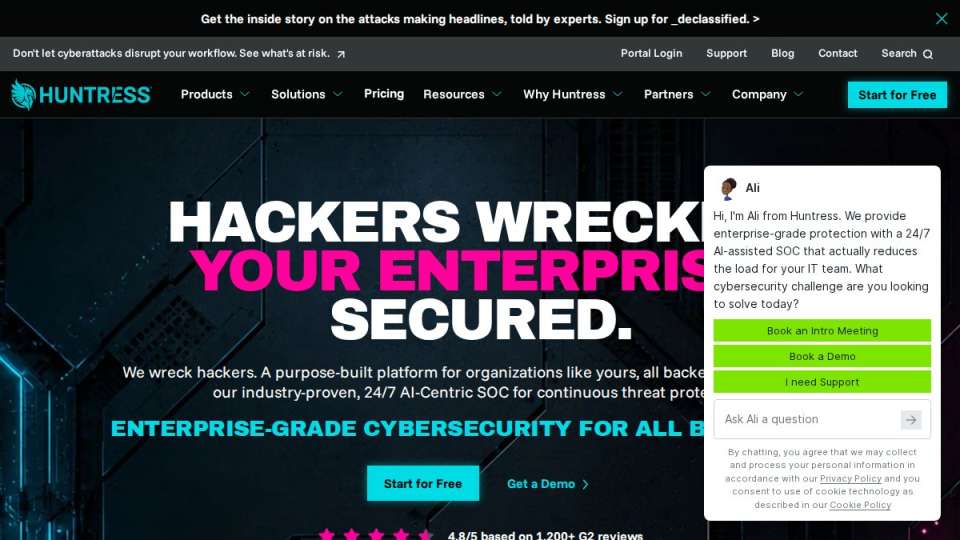
Huntress Managed EDR: Best Entry-Level 24/7 SOC Coverage
Huntress is an accessible credible 24/7 MDR solution for small businesses.
Every alert is reviewed by a human analyst in Huntress's SOC before action is taken, eliminating false-positive fatigue. Coverage spans Windows, Mac, and Linux endpoints. Microsoft 365 identity threat detection is available as an add-on.
Pricing is $8.99 per endpoint per month direct, or significantly less through an MSP partner. No annual lock-in; billing is monthly. Security Awareness Training is included.
Sophos Managed Threat Response: Enterprise-Grade for SMBs
Sophos MTR occupies the middle ground between entry-level EDR and full enterprise MDR effectively.
The service provides 24/7 threat hunting and detection by a human expert team, with EDR and XDR capabilities and a documented 8-hour response SLA. Sophos MTR works alongside Microsoft Defender, CrowdStrike, and SentinelOne, so businesses do not need to replace existing security stacks.
Pricing starts at $79 per user per year for MTR, with MDR Essentials and Complete tiers available at lower per-endpoint annual rates.
CrowdStrike Falcon Go: Transparent Self-Service Endpoint Protection
CrowdStrike Falcon Go is not a full managed security service. It is a self-service endpoint protection bundle for small businesses wanting enterprise-grade technology without a managed service wrapper.
The product includes next-generation antivirus, USB device control, and mobile protection for Android and iOS. Deployment takes minutes with no reboots required. Pricing is $59.99 per device per year, capped at 100 devices, with a 15-day free trial.
The pricing is transparent, which is rare in this category. There is no 24/7 SOC monitoring included; your team is responsible for acting on alerts.
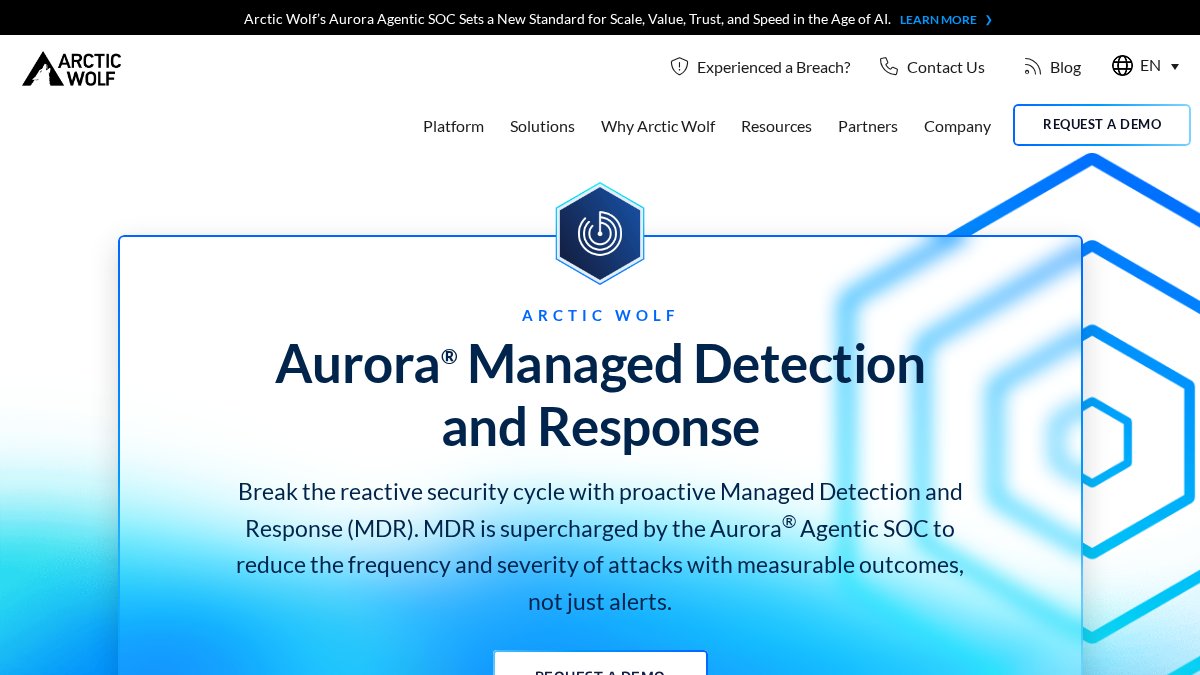
Arctic Wolf MDR: Relationship-Led Security for Mature SMBs
Arctic Wolf is a premium option. Each client receives a named Concierge Security Team providing ongoing guidance, posture coaching, and compliance-aligned reviews. Coverage spans endpoints, networks, and cloud environments across AWS, Azure, and Google Cloud. Arctic Wolf offers a $3M breach prevention warranty, a meaningful commitment most MDR providers avoid.
Pricing starts at approximately $44,000 per year for up to 100 users. The named team model creates accountability that anonymous SOC coverage cannot replicate.
MSSP Pricing for Small Business: What to Expect and How to Compare
MSSP pricing varies significantly based on scope, coverage level, and contract structure. Common pricing models include:
- Per endpoint per month: Predictable scaling (Huntress: $8.99/endpoint direct)
- Per user per year: Broader MDR services (Sophos MTR: starts at $79/user/year)
- Per device per year: Self-service endpoint protection (CrowdStrike Falcon Go: $59.99/device/year)
- Custom annual contract: Full managed security with named team (Arctic Wolf: from approximately $44,000/year for 100 users)
- All-inclusive managed model: IT and security bundled (VegaMSP: contact for quote)
In-House Security vs. Outsourced MSSP: The Real Cost Difference
Building in-house security operations requires at minimum a security analyst, a SIEM platform, endpoint protection tools, and management overhead. For most small businesses, the fully-loaded annual cost of a mid-level security analyst exceeds comprehensive managed security service costs.
The outsourced model provides access to threat intelligence, SOC infrastructure, and experienced analysts that no single hire replicates. A solo analyst cannot provide 24/7 coverage or bring the collective detection experience of a team monitoring thousands of environments simultaneously.
Cybersecurity Checklist for Small Business: What Your Stack Should Include
Use this baseline audit to assess your cybersecurity coverage:
Endpoint Security
- Next-generation antivirus or EDR deployed on all devices (Windows, Mac, mobile)
- Automated patch management for OS and third-party applications
- USB and removable media controls enabled
- Mobile device management for company-owned and BYOD devices
Network Security
- Next-generation firewall with intrusion detection
- Network segmentation separating guest, employee, and server traffic
- DNS filtering to block malicious domains
- VPN for remote access with multi-factor authentication enforced
Identity and Access
- Multi-factor authentication on all cloud services and email
- Privileged access management: no standing admin accounts for daily use
- Regular access reviews: remove terminated employee accounts within 24 hours
Detection and Response
- 24/7 monitoring with human-reviewed alerting
- Documented incident response plan with defined roles and escalation paths
- Security event logging retained for a minimum of 90 days
Backup and Recovery
- Automated daily backups with offsite or cloud copy
- Tested recovery procedures
- Ransomware-resistant backup architecture (immutable or air-gapped)
Human Layer
- Security awareness training completed by all employees, minimum annually
- Phishing simulation program in place
- Clear policy for reporting suspicious emails or activity
Small Business Cybersecurity Compliance Requirements You Can't Ignore
Compliance requirements depend on your industry and data type. The most common frameworks affecting US small businesses are:
HIPAA applies to any business handling protected health information. The HHS HIPAA Security Rule guidance mandates administrative, physical, and technical safeguards for electronic health data.
PCI DSS applies to any business accepting, processing, or storing credit card data. Compliance requires network security controls, access management, and regular security testing regardless of business size.
SOC 2 is not legally required but increasingly demanded by enterprise customers as a condition of doing business.
State-level privacy laws are expanding. California's CCPA, Virginia's CDPA, and similar laws impose data handling requirements on businesses collecting consumer information, often regardless of company size.
How Compliance Aligns With Cyber Insurance Requirements
Cyber insurance underwriters have become significantly more rigorous. Many policies now require specific controls as a condition of coverage, including multi-factor authentication, endpoint detection and response, and documented incident response procedures.
A managed security service including compliance reporting and security audits directly supports insurability. Aligning your security stack with insurance requirements is the most practical way to ensure you cover the right controls.
How to Choose the Right Managed Security Partner for Your Business
Choosing a managed security partner is a vendor relationship decision determining how quickly threats are detected, how effectively incidents are contained, and whether your business can demonstrate security posture to customers, regulators, and insurers.

Start with these evaluation criteria:
1. Scope of coverage: Does the provider cover endpoints, network, cloud, and identity, or only one layer? Gaps are where breaches happen.
2. Response model: Is monitoring automated-only, or does a human analyst review alerts before action? Human-led SOC coverage is worth the premium.
3. Integration with existing infrastructure: Prioritize providers working with what you have rather than requiring full stack replacement.
4. SLA commitments: What is the documented response time? An 8-hour SLA is a concrete commitment; "we respond quickly" is not.
5. Compliance support: Can the provider generate documentation for HIPAA, PCI DSS, or SOC 2 audits? This is non-negotiable if compliance is required in your industry.
6. Pricing transparency: Per-endpoint and per-user models are easier to budget than custom quotes. Understand all-in cost including onboarding and add-ons before committing.
7. Integration with your MSP: If you have a managed service provider handling IT operations, your security provider should integrate with that relationship.
| Evaluation Criterion | What to Ask | Why It Matters |
|---|---|---|
| Coverage scope | Endpoints only, or network + cloud + identity? | Gaps create breach entry points |
| Response model | Human SOC or automated-only? | Human review reduces false positives |
| SLA | Documented response time commitment? | Vague promises do not hold up in a breach |
| Compliance support | Can they generate audit documentation? | Required for HIPAA, PCI DSS, insurance |
| Pricing model | Per-endpoint, per-user, or custom quote? | Predictability matters for budget planning |
| MSP integration | Does it work with your existing IT provider? | Avoids parallel vendor management |
Cybersecurity frameworks and compliance requirements evolve. For current regulatory guidance, refer to NIST's Small Business Cybersecurity resources for up-to-date standards and implementation guidance.
Managing cybersecurity without a dedicated internal team is one of the most common and consequential gaps in small business operations. The providers in this guide represent a range of approaches, from self-service endpoint protection to fully managed 24/7 SOC coverage. The most effective model for most growing businesses integrates IT management and security under a single provider. VegaMSP's Secure-IT-In-The-Box approach delivers fully managed network services, endpoint security, VoIP integration, and unlimited helpdesk support in one arrangement, eliminating vendor gaps where threats typically go undetected. Get started with VegaMSP and build a security posture that scales with your business.
Frequently Asked Questions
What is a managed security service provider (MSSP) for small business?
A managed security service provider is a third-party company that monitors and manages your cybersecurity infrastructure on your behalf. For small businesses, an MSSP typically delivers 24/7 threat monitoring, endpoint protection, incident response, vulnerability management, and compliance reporting. Rather than hiring a full in-house security team, you pay a predictable monthly fee to access a security operations center and expert analysts who protect your network around the clock.
Do small businesses really need managed security services?
Small businesses are frequent targets precisely because attackers assume their defenses are weaker than larger enterprises. Phishing, ransomware, and credential theft hit organizations of all sizes. Managed security services give small teams access to proactive defense, real-time alerts, and incident response capabilities they could not afford to build internally. For businesses handling customer data, payment information, or operating under compliance frameworks like HIPAA or PCI DSS, outsourced security is often a practical necessity.
How much do managed security services cost for small businesses?
MSSP pricing for small business varies widely by service scope and provider. Entry-level endpoint detection tools like Huntress start around $8.99 per endpoint per month when purchased directly, or less through an MSP partner. Broader managed detection and response platforms can run from a few thousand dollars annually for small teams up to $44,000 or more per year for comprehensive, named-team services like Arctic Wolf. VegaMSP pricing depends on your specific environment and service needs; contact them directly for a quote tailored to your team size.
What is the difference between an MSP and an MSSP?
A managed service provider (MSP) handles general IT operations: helpdesk support, network management, software patching, and device monitoring. A managed security service provider (MSSP) focuses specifically on cybersecurity: threat detection, incident response, security audits, and compliance management. Many businesses work with both, or choose a provider like VegaMSP that combines fully managed IT services with integrated endpoint security, effectively delivering both functions under one contract without managing two separate vendor relationships.
How do I choose the best MSSP for my small business?
Start by identifying your compliance obligations, your current security gaps, and your budget range. Then evaluate providers on four criteria: whether they offer 24/7 monitoring with a real security operations center, how they handle incident response and recovery, whether their pricing model scales with your team size, and whether they integrate with your existing tools like your CRM or VoIP system. Ask for documented response time SLAs and proof of past breach prevention outcomes before signing any contract.
This article was written using GrandRanker