 listicle
Best Managed IT Services for 2026: Top Providers Ranked
Table of Contents
- How We Selected the Best Managed IT Services for 2026
- Quick Comparison: Top Managed IT Services Providers at a Glance
- 1. VegaMSP: Secure-IT-In-The-Box for SMBs That Need to Scale
- 2. Rackspace Technology: Best for Complex Multi-Cloud Environments
- 3. Presidio Managed Services: Best for Mid-Market Security and Networking
- 4. Insight Managed Cloud Services: Best for Cloud Cost Optimization
- 5. NTT DATA: Best for AI-Driven Network Operations at Enterprise Scale
- MSP vs. Internal IT Team Comparison: Which Makes Sense in 2026
Last Updated: August 3, 2026
Choosing the best managed IT services for 2026 is one of the most consequential infrastructure decisions a growing business can make. Most companies treat it as a commodity purchase, which is a mistake. Below, we'll show you which gaps most buyers overlook, and why the right choice depends on your size, compliance requirements, and growth trajectory.
A Fortune 500 MSP is not automatically the right answer for a 50-person professional services firm.
Quick Picks:
- Best for SMBs that need to scale: VegaMSP - Secure-IT-In-The-Box with unlimited helpdesk support
- Best for complex multi-cloud: Rackspace Technology - deep multi-cloud expertise with 15-minute emergency response
- Best for mid-market security: Presidio Managed Services - ITIL/ISO 27001-certified SOC
- Best for cloud cost optimization: Insight Managed Cloud Services - structured cloud spend reduction
- Best for AI-driven enterprise networking: NTT DATA - predictive, self-healing network operations
How We Selected the Best Managed IT Services for 2026
Selecting the best managed IT services requires a disciplined evaluation framework, not a vendor shortlist built from sales calls. The managed IT services market is crowded with providers claiming proactive maintenance, 24/7 monitoring, and enterprise-grade security. The real differentiators live in the details.
Core Evaluation Criteria
We evaluated each provider across seven dimensions:
- Service Level Agreement terms: Specific uptime guarantees, incident response windows, and escalation paths
- Cybersecurity posture: Endpoint protection depth, threat detection methodology, and security operations center maturity
- Help desk support quality: First-contact resolution rates, average response time, and support tier structure
- Scalability: Can the provider grow with you from 20 users to 200 without a full re-contract?
- Compliance auditing: SOC 2, HIPAA, PCI-DSS, and CMMC readiness for regulated industries
- Pricing model transparency: Predictable per-seat or per-device pricing vs. opaque consumption models
- Exit strategy and vendor lock-in risk: Contract flexibility, data portability, and transition support
According to Gartner's IT Outsourcing research, the top reason organizations switch MSPs is unmet SLA expectations, not pricing. That finding shaped our weighting: a provider with a cheaper per-seat rate but vague SLA language scored lower than a slightly more expensive provider with contractual uptime guarantees and defined incident response windows.
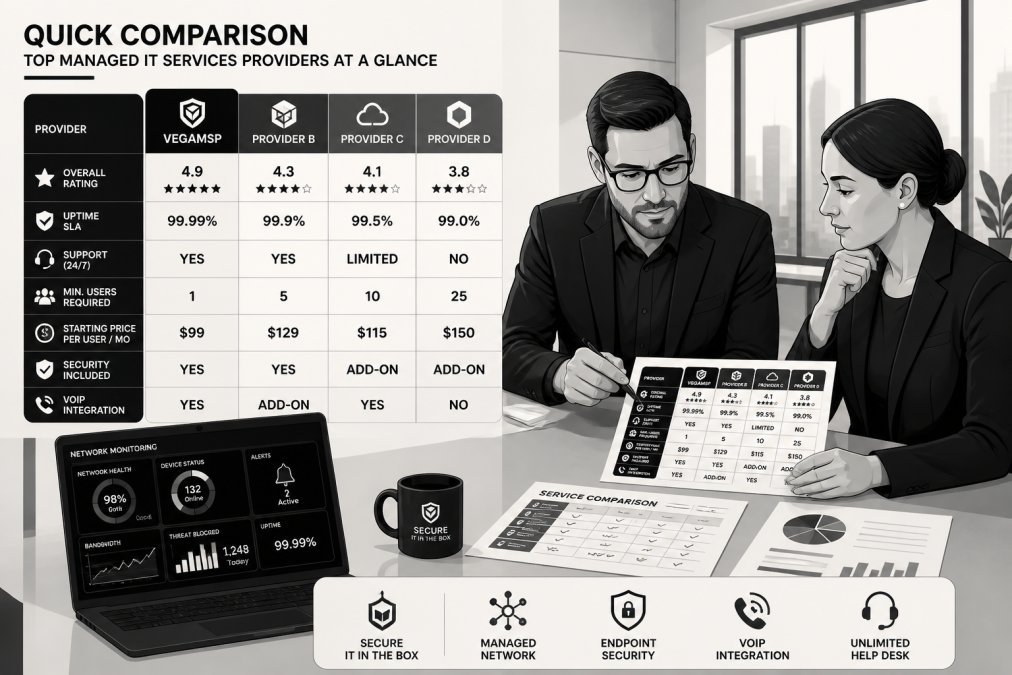
Quick Comparison: Top Managed IT Services Providers at a Glance
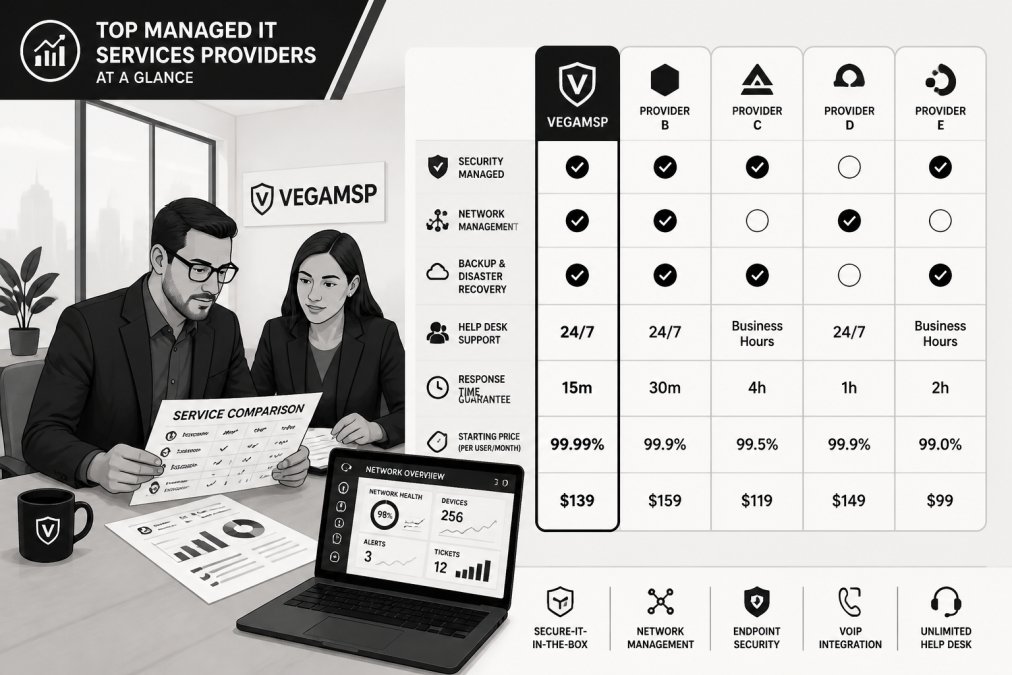
| Provider | Best For | Pricing Model | SLA Response | Standout Feature |
|---|---|---|---|---|
| VegaMSP | SMBs, 10-250 employees | Contact for quote | Defined SLA | Unlimited helpdesk, VoIP integration |
| Rackspace Technology | Multi-cloud environments | % of cloud spend + fixed fees | 15-min emergency | Fanatical Support across AWS/Azure/GCP |
| Presidio Managed Services | Mid-market security/networking | From ~$10K/month | ITIL-aligned | ISO 27001-certified SOC |
| Insight Managed Cloud Services | Cloud cost optimization | From ~$2K/month | 24/7 defined tiers | 20-30% cloud spend reduction |
| NTT DATA | Enterprise AI-driven networking | Custom | High first-contact resolution | Self-healing AI network ops |
Pricing shown for Rackspace, Presidio, Insight, and NTT DATA reflects publicly available or researched data from each provider's published materials. VegaMSP pricing is customized based on environment size and service scope; contact VegaMSP directly for a current quote.
1. VegaMSP: Secure-IT-In-The-Box for SMBs That Need to Scale
VegaMSP is the top pick for US businesses with 10 to 250 employees that need fully managed IT without the complexity of enterprise-tier providers. The Secure-IT-In-The-Box model covers network infrastructure, endpoint security, VoIP integration, and unlimited helpdesk support under a single engagement.
The unlimited helpdesk support is the standout feature. Many MSPs advertise "included support" that routes to tiered queues with hours-long wait times. VegaMSP's model eliminates that friction.
What works:
- Fully managed network services with proactive maintenance built in
- Endpoint security designed to prevent breaches, not just detect them after the fact
- Seamless VoIP integration that preserves existing CRM connections during transition
- Designed specifically for businesses that are scaling
What to know upfront:
- Pricing is not published publicly; you'll need a scoping call for an accurate quote
- Best fit is 10-250 employees; very large organizations may need a different tier
Security threats don't scale down for small businesses. The average SMB faces the same ransomware campaigns and phishing attacks as a mid-market firm, but with fewer internal resources to respond. A fully managed endpoint protection and network monitoring model makes sense at any size.
2. Rackspace Technology: Best for Complex Multi-Cloud Environments
Multi-cloud management is genuinely hard. Most organizations running workloads across AWS, Microsoft Azure, and Google Cloud simultaneously deal with cost sprawl, inconsistent security configurations, and fragmented visibility. Rackspace Technology was built for exactly this problem.
Rackspace's Fanatical Support model includes a 15-minute emergency response SLA, one of the most aggressive commitments in the managed cloud market. Coverage spans 24x7x365 monitoring, automated patching, backup management, and incident response across all three major hyperscalers plus private cloud infrastructure.
What works:
- Genuine multi-cloud expertise across AWS, Azure, GCP, and OpenStack
- AI-driven operations for predictive issue detection and self-healing capabilities
- Cloud migration and application modernization services alongside ongoing management
- Documented exit strategy support for cloud environments
What doesn't:
- Pricing is customized; minimum monthly commitments apply
- Not the right fit for businesses needing primarily endpoint management or on-site support
Rackspace's documented approach to helping clients transition workloads is uncommon and meaningful for organizations concerned about vendor lock-in.
3. Presidio Managed Services: Best for Mid-Market Security and Networking
Presidio operates at a different price point than most SMB-focused providers, with engagements typically starting around $10,000 per month. That entry point signals a level of service depth and dedicated engineering capacity that lower-cost providers cannot match.
Their security operations center holds ITIL and ISO 27001 certifications, which matters significantly for organizations in healthcare, financial services, and the public sector where compliance auditing is a contractual requirement.
What works:
- Full-lifecycle system integration from procurement through managed services
- Cloud security across AWS, Azure, and GCP with unified visibility
- Proactive network monitoring with defined incident response protocols
- Strong track record in regulated industries with documented compliance posture
What doesn't:
- Entry pricing makes Presidio impractical for businesses under 100 employees
- Security practice is horizontal, not a pure-play security depth
4. Insight Managed Cloud Services: Best for Cloud Cost Optimization
Cloud cost optimization is one of those areas where the gap between promise and delivery is enormous. Most organizations know they're overspending on cloud infrastructure; few have the internal expertise to identify and eliminate the waste systematically.
Insight Managed Cloud Services targets mid-sized businesses in the 500 to 5,000 employee range that need enterprise-grade cloud management without building an internal cloud operations team. Their consumption-based pricing model starts around $2,000 per month depending on the number of cloud resources under management.
What works:
- Proactive monitoring with automated alerting, patch management, and compliance configuration
- Cloud cost forecasting and optimization as a core deliverable
- Dedicated account teams with defined 24/7 technical support response tiers
- Strong partnerships with AWS, Azure, and Google Cloud
What doesn't:
- Focus is explicitly cloud; organizations needing comprehensive on-premises or end-user IT management will need to supplement
- Pricing variability based on resource count can make budgeting unpredictable at scale
Organizations that approach cloud spend management reactively see costs compound over time as unused resources accumulate.
5. NTT DATA: Best for AI-Driven Network Operations at Enterprise Scale
AI-driven IT automation is becoming table stakes for enterprise network management. NTT DATA has moved further along that curve than most competitors, with predictive analytics and self-healing network capabilities embedded into their core managed network services platform.
Their full-stack observability model provides real-time visibility across wired and wireless infrastructure, with automated configuration updates that reduce manual intervention.
What works:
- Predictive insights that identify network issues before they cause downtime
- Self-healing capabilities that reduce mean time to resolution without human intervention
- High first-contact resolution rates for service issues
- Extensive global delivery capabilities for multinational organizations
What doesn't:
- Pricing requires direct engagement; no public rate card exists
- Some users have reported delays with complex escalations
As documented in NIST's cybersecurity framework guidance, proactive threat detection and automated incident response are foundational requirements for organizations managing critical network infrastructure.
MSP vs. Internal IT Team Comparison: Which Makes Sense in 2026
The MSP vs. internal IT debate is framed incorrectly most of the time. The real question isn't "which is better" but "which is appropriate for our current size, risk profile, and growth rate."
For most US businesses under 250 employees, a fully managed IT services model outperforms an internal team on cost, coverage breadth, and security depth. A single internal IT hire covers roughly 8 hours per day, 5 days per week, with no coverage during illness, vacation, or turnover. A managed services provider delivers 24/7 monitoring, remote management, and incident response continuity.
| Factor | Internal IT Team | Managed IT Services |
|---|---|---|
| Coverage hours | Business hours only | 24/7/365 |
| Security expertise | Generalist | Specialized teams |
| Scalability | Hire lag (weeks/months) | Immediate scope adjustment |
| Cost predictability | Variable (salary, benefits, tools) | Fixed monthly or per-seat |
| Compliance auditing | Requires additional expertise | Often included |
| Disaster recovery | Depends on individual knowledge | Documented, tested processes |
| Vendor management | Internal burden | MSP-managed |
The case for internal IT strengthens at larger organizations (typically 500+ employees) where the volume of support requests, internal development needs, and strategic IT planning justify dedicated headcount.
Hidden Costs of In-House IT Most Businesses Undercount
The most common mistake in the MSP vs. internal IT analysis is comparing the MSP monthly fee to a single IT salary. That comparison ignores the full cost stack: salary, benefits, payroll taxes, training and certification costs, software licensing for management tools, after-hours on-call compensation, and the productivity cost of every hour your IT person spends on routine maintenance rather than strategic work.
According to CompTIA's State of the Channel research, the total cost of IT ownership for small businesses consistently exceeds initial estimates when all operational, security, and downtime costs are factored in. Businesses that switch from break-fix or internal-only models to fully managed services typically find that predictable monthly costs are lower than the true all-in cost of their previous approach.
Internal IT teams at small businesses frequently defer infrastructure upgrades, security patches, and system integration work because they're consumed by day-to-day support requests. A managed services provider with proactive maintenance built into the SLA prevents that accumulation by design.
Choosing the right managed IT services provider in 2026 means matching provider capabilities to your actual size, security requirements, and growth trajectory rather than defaulting to the largest brand name. For US businesses with 10 to 250 employees, VegaMSP's Secure-IT-In-The-Box model delivers fully managed network services, endpoint security, VoIP integration, and unlimited helpdesk support in a single, accountable engagement. Get started with VegaMSP and eliminate the downtime, security gaps, and IT overhead that hold growing businesses back.
Frequently Asked Questions
What should I look for in a managed IT services provider in 2026?
Prioritize providers that offer a documented service level agreement with defined uptime guarantees and incident response times, proactive remote monitoring and management, endpoint protection, and disaster recovery planning. For 2026 specifically, ask whether the MSP uses AI-driven automation for threat detection and whether they can supply documentation that satisfies cyber-insurance underwriters. Security operations center access and compliance auditing capabilities are also worth confirming before signing any contract.
What is the difference between break-fix IT support and managed IT services?
Break-fix support means you call a technician after something fails and pay per incident. Managed IT services replace that reactive model with a flat, predictable fee covering proactive maintenance, network monitoring, help desk support, and backup solutions around the clock. The managed model reduces technical debt because problems are caught before they cause downtime, whereas break-fix costs spike unpredictably and offer no business continuity planning between incidents.
How do managed IT services pricing models work for small US businesses in 2026?
The three most common managed IT services pricing models are per-user, per-device, and all-inclusive flat fee. Per-user pricing scales cleanly as headcount changes. Per-device pricing suits organizations with many unattended endpoints. All-inclusive flat-fee contracts bundle helpdesk support, endpoint security, and cloud migration assistance into one monthly figure, making budgeting straightforward. Because pricing depends on company size, service scope, and SLA tier, request an itemized quote rather than relying on industry averages.
How do I transition to a new managed IT services provider without causing downtime?
A structured onboarding plan is the difference between a smooth cutover and weeks of disruption. Before switching, demand a written transition timeline covering asset discovery, credential transfer, backup verification, and parallel-run periods. Confirm the new MSP will document your existing network architecture before making any changes. Ask specifically how VoIP integrations and CRM connections are preserved during migration. Providers with a formal onboarding playbook and a dedicated project lead reduce transition risk significantly.
What security and compliance standards should a US-based MSP follow in 2026?
At minimum, a US-based MSP should align with NIST Cybersecurity Framework controls, support HIPAA or PCI-DSS requirements if your industry demands it, and maintain SOC 2 Type II certification for their own operations. For 2026, cyber-insurance carriers increasingly require proof of multi-factor authentication, data encryption at rest and in transit, and documented incident response procedures. Ask any MSP candidate to share their most recent compliance audit results and confirm their managed security services cover these requirements explicitly.
Are managed IT services worth the investment for a company with only 10 to 15 employees?
Yes, and often more so than for larger organizations. Small teams have the most to lose from a single outage or breach because there is no internal IT staff to absorb the impact. A fully managed model with unlimited helpdesk support gives a 15-person company the same operational efficiency and cybersecurity posture as a much larger organization, at a predictable monthly cost. The ROI case strengthens further when you factor in the salary, benefits, and training costs of hiring even one full-time IT employee.
This article was written using GrandRanker