 how-to
How to Evaluate Managed IT Provider Security
Table of Contents
- Why Evaluating Managed IT Provider Security Matters
- Step 1: Verify Security Certifications and Compliance Standards
- Step 2: Assess Endpoint Detection and Response Capabilities
- Step 3: Review Incident Response and Disaster Recovery Plans
- Step 4: Ask Critical Questions to Managed IT Providers About Cybersecurity
- Step 5: Use an MSP Security Due Diligence Checklist
- Step 6: Evaluate Cultural Fit and Communication
- Red Flags to Watch During Your Evaluation
Last Updated: August 11, 2026
Why Evaluating Managed IT Provider Security Matters
Choosing the wrong managed IT provider can cost your business far more than the contract price. A single security breach, unplanned downtime, or misconfigured endpoint can compromise customer data, disrupt operations, and damage your reputation. This is why learning how to evaluate managed IT provider security has become essential for any growing business.
At VegaMSP, we've worked with companies making this decision. Most approach vendor selection backwards: they focus on price and ask surface-level questions, then realize six months in, when a breach happens or response times slip, they never verified what they were buying.
Ransomware attacks target small and mid-sized businesses specifically because they assume weaker defenses. Regulatory compliance requirements keep expanding. This guide walks you through a systematic approach to evaluate managed IT provider security before you sign anything.
Step 1: Verify Security Certifications and Compliance Standards
Don't assume a provider has legitimate security credentials just because they mention them in marketing. Certifications require third-party audits, specific controls, and ongoing compliance verification.
SOC 2 Type II and other critical certifications
SOC 2 Type II certification is the gold standard for managed service providers. An independent auditor verifies the provider maintains security controls across access, processing integrity, confidentiality, and availability over a minimum six-month observation period. Type II matters because it proves sustained compliance, not just a single audit snapshot.
When you request a SOC 2 report, the provider should provide it without hesitation. If they claim confidentiality concerns, ask for a summary or attestation letter signed by their auditor. If a provider claims SOC 2 but can't produce documentation, move on.
Beyond SOC 2, look for ISO 27001 certification, which covers information security management systems. Ask about annual penetration testing and request a summary of findings and remediation timelines.
HIPAA, ISO 27001, and industry-specific requirements
If your business handles healthcare data, HIPAA compliance is non-negotiable. A provider claiming HIPAA compliance should provide a Business Associate Agreement (BAA) before you sign. Without a BAA, you're exposed to regulatory violations even if the provider breaches your data.
ISO 27001 requires a documented information security management system, annual audits, and demonstrated continuous improvement. If your industry has specific compliance needs, financial services (SOC 2 is mandatory), healthcare (HIPAA + BAA), or data-sensitive verticals, verify the provider holds the exact certifications required.
Step 2: Assess Endpoint Detection and Response Capabilities
Endpoint detection and response (EDR) is where modern security happens. A managed provider without strong EDR capabilities is essentially offering break-fix support dressed up as security management.
Real-time threat monitoring and alerting
Ask the provider specifically what EDR platform they use and how they monitor your endpoints. Real-time monitoring means threats are detected within minutes, not hours or days. The provider should have a security operations center (SOC) staffed to review alerts, triage severity, and escalate critical threats immediately.
Ask about their alert response time. A legitimate answer sounds like: "Critical alerts are reviewed within 15 minutes, and we escalate to your team immediately." Threat intelligence integration matters, the provider should feed threat data from external sources and vulnerability databases into their monitoring to recognize known attack patterns faster.
Ask how they handle false positives. A high false-positive rate wastes your team's time. A mature provider has tuned their alerts to balance sensitivity and specificity.
Vulnerability management and patch deployment
A managed provider should automatically scan your systems for vulnerabilities on a regular schedule, ideally weekly or more frequently. They should prioritize patches by severity and deploy them according to a documented schedule. Ask what their patch deployment timeline looks like: critical patches within 48 hours, important patches within two weeks.
Ask about their testing process before deployment. Patches sometimes break applications or cause compatibility issues. A responsible provider tests patches in a staging environment before pushing to production.
Step 3: Review Incident Response and Disaster Recovery Plans
When a breach or outage happens, the difference between quick recovery and catastrophic failure comes down to whether the provider has a documented incident response plan and the capability to execute it.
Response time commitments and escalation procedures
Ask for the provider's incident response plan in writing. It should document how they classify severity levels, who gets notified, and what response times they commit to. A serious provider will have something like:
- Critical (system down, data breach suspected): notification within 15 minutes, investigation begins immediately
- High (significant performance degradation): notification within 1 hour, investigation within 2 hours
- Medium (isolated system issues): notification within 4 hours, investigation within 8 hours
- Low (minor issues, no business impact): notification within 24 hours
Ask who escalates to your team and how. In a real incident, email is too slow. There should be a clear escalation path with direct phone numbers and backup contacts.
Ask about their on-call coverage. Do they have 24/7 on-call staff, or do they only respond during business hours?
Business continuity and data recovery timelines
Ask the provider about their backup strategy. How frequently are your backups taken? Where are they stored? Can they recover a single file, an entire server, or your whole infrastructure?
A solid backup strategy includes daily incremental backups, weekly full backups, backups stored both on-site and off-site, and regular restoration tests to verify backups actually work.
Ask about their Recovery Time Objective (RTO) and Recovery Point Objective (RPO). RTO is how long it takes to restore service after a failure. RPO is how much data you're willing to lose. Ask specifically about ransomware recovery and whether backups are isolated from live systems.
Step 4: Ask Critical Questions to Managed IT Providers About Cybersecurity
This is where the real evaluation happens. The questions you ask will reveal whether a provider has genuine expertise or is just reading from a sales script.
Security operations center staffing and expertise
Ask how many people work in their SOC and what their certifications are. A provider with five people monitoring security for hundreds of clients is understaffed. Look for providers whose SOC staff hold certifications like CISSP, CEH, or GIAC Security Essentials.
Ask about their average tenure in the SOC. High turnover means institutional knowledge walks out the door.
Threat intelligence and zero trust architecture implementation
Ask what threat intelligence sources they use. Do they subscribe to commercial threat feeds? Do they participate in information-sharing groups?
Ask about their approach to zero trust architecture. Zero trust means every access request is verified, regardless of source. This is the modern security standard. Ask how they handle multi-factor authentication (MFA). MFA should be mandatory for all remote access and administrative functions.
Exit strategy and data ownership
If you ever need to switch providers, what happens to your data? Ask explicitly:
- Will the provider provide your data in a standard format you can import elsewhere?
- How long do they retain your data after contract termination?
- What's the process for data handoff, and who pays for migration assistance?
- Can they provide a clean copy of your systems for backup before transition?
A provider confident in their service will have a straightforward answer. A provider that gets defensive is signaling they want to lock you in.
Step 5: Use an MSP Security Due Diligence Checklist
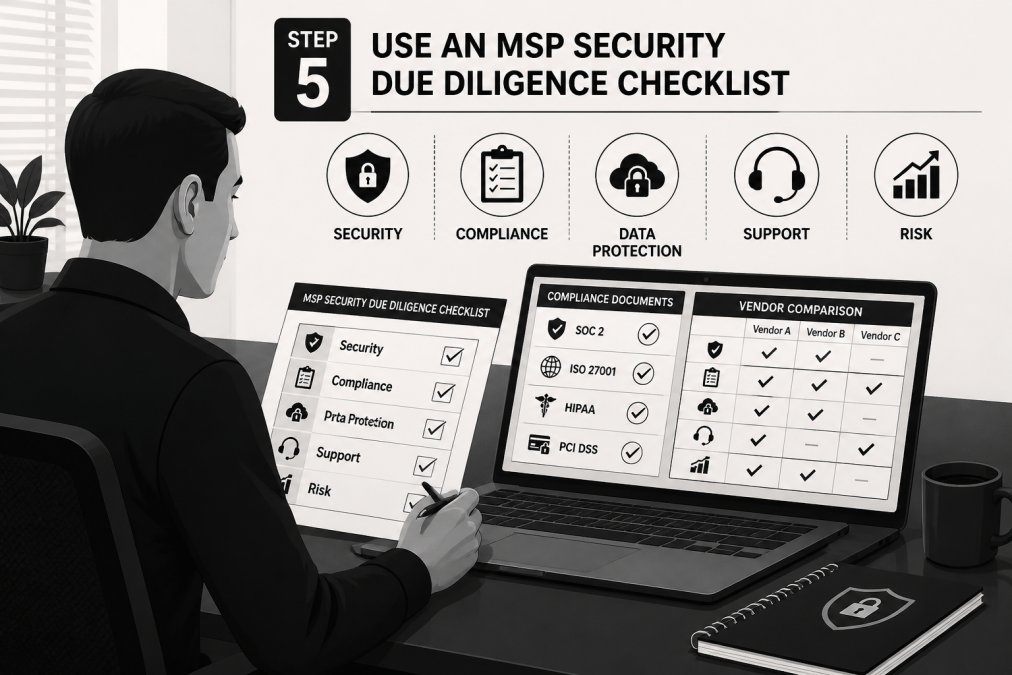
A comprehensive evaluation requires a structured approach. Use this checklist to score providers consistently and compare apples to apples. Rate each item on a scale: Not Met (0), Partially Met (1), Fully Met (2).
Service level agreements and uptime guarantees
Examine the provider's SLA carefully. A 99.5% uptime guarantee is 21 minutes of downtime per month. 99.9% means 4 minutes per month. 99.99% means 26 seconds per month and is expensive.
Ask what happens if they miss their SLA. Do they provide service credits? Read the fine print. Some providers have so many exceptions that the SLA is nearly meaningless.
Security audit frequency and vendor risk management
Ask how often they conduct security audits and who performs them. Third-party audits are more credible than self-assessments. Annual audits are the minimum.
Ask about their vendor risk management process. Your provider uses other vendors, cloud platforms, and software tools. Does the provider vet those vendors' security practices?
Financial stability, insurance, and supply chain risk
Ask about the provider's financial health. Are they profitable? Have they received recent funding? Are they stable enough to be around in five years?
Ask about cyber liability insurance. If the provider causes a breach through negligence, will their insurance cover your losses? What's the coverage limit?
Step 6: Evaluate Cultural Fit and Communication
Technical security controls matter, but so does whether you can actually work with the provider day-to-day. A provider with perfect security posture but terrible communication will frustrate you constantly.
Ask about their communication cadence. How often will they provide reports? Will you get monthly security reviews? Ask about their escalation process when issues arise and whether they assign a dedicated account manager.
Ask how they handle change management. If they need to update security configurations or patch systems, do they notify you in advance? Ask about their willingness to customize to your specific needs.
Red Flags to Watch During Your Evaluation
Certain warning signs should disqualify a provider immediately.
Vague answers about security: A provider that can't explain their security approach in concrete terms either doesn't understand it or is hiding something.
Pressure to sign quickly: Reputable providers understand due diligence takes time.
No written incident response plan: If they can't provide documentation of how they respond to incidents, they haven't thought it through.
Unwillingness to provide references: Ask for references from businesses similar to yours.
Claiming 100% uptime or zero breaches: No provider can guarantee zero breaches. Security is about risk reduction, not elimination.
Inability to explain their technology stack: A provider should be able to tell you exactly what tools and platforms they use and why.
Refusing to discuss pricing models: Request a detailed breakdown of what's included and what costs extra.
Evaluating a managed IT provider security posture takes time and rigor, but it's time well spent. The wrong choice creates ongoing security risks and operational headaches. The right choice gives you peace of mind, frees your team to focus on growth, and ensures your infrastructure is protected by professionals who take security seriously.
When you find a provider that answers your questions directly, provides documentation to back up their claims, and demonstrates genuine expertise, you've found a partner worth investing in. VegaMSP is built for businesses that demand this level of security rigor. Our fully managed network services, strong endpoint security, and unlimited helpdesk support ensure your infrastructure is protected while your team focuses on what matters most. Learn more about how managed IT providers approach security compliance to understand the standards your provider should meet.
Frequently Asked Questions
What security certifications should a managed IT provider have?
A reputable managed IT provider should hold SOC 2 Type II certification, which demonstrates independent verification of security controls. Depending on your industry, require HIPAA (healthcare), PCI DSS (payment processing), or ISO 27001 (information security). Ask for proof of current certifications and when audits are scheduled. Don't accept promises of 'in-progress' certifications, require active, valid credentials.
What questions should you ask managed IT providers about cybersecurity?
Ask about their security operations center staffing, incident response time, endpoint detection capabilities, and disaster recovery testing frequency. Request details on their threat intelligence sources and zero trust architecture implementation. Critically, ask about your data ownership if you need to switch providers, their cyber liability insurance coverage, and how they assess supply chain risks among their own vendors. These questions reveal depth of security maturity.
How do you assess an MSP's cybersecurity maturity?
Review their SOC 2 compliance audit reports, which detail their security controls and operational effectiveness. Examine their service level agreements for specific uptime guarantees and incident response times. Ask for evidence of recent security audits and penetration testing results. Check whether they use multi-factor authentication, maintain real-time alerting systems, and conduct regular security awareness training for their own staff. Mature providers document all of this transparently.
What should be included in an MSP security service level agreement?
An SLA must specify incident response times (e.g., critical alerts within 15 minutes), mean time to resolution targets, uptime guarantees (typically 99.5% or higher), and escalation procedures. It should detail backup and disaster recovery timelines, security audit frequency, and remediation strategy commitments. Include penalties for SLA breaches and define what constitutes a security incident. A weak SLA is a major red flag, providers confident in their security will commit to measurable standards.
This article was written using GrandRanker