 how-to
How to Evaluate Managed IT Service Providers
Table of Contents
- Assess Your Business Needs and Goals Before Evaluating Providers
- Verify Technical Expertise and Industry-Specific Experience
- Review Service Scope and Cybersecurity Capabilities
- Key Questions to Ask a Managed Service Provider
- Create a Managed Service Provider Evaluation Checklist
- Review MSP Contract Terms and Service-Level Agreements
- Compare Managed IT Provider Pricing and Total Cost of Ownership
- Validate Security Posture and Request Evidence of Risk Management
- Frequently Asked Questions
Last Updated: October 4, 2026
Assess Your Business Needs and Goals Before Evaluating Providers
Before you evaluate managed IT service providers, understand what your business actually requires. Many organizations skip this step and end up with solutions that don't fit their real problems.
Document your current IT environment: what systems run today, which cause the most downtime, and where teams struggle most with support.
Define your business goals: reduce downtime, cut IT costs, improve security, or scale without hiring more IT staff. Different goals point to different provider strengths.
Consider your growth timeline. If you're doubling headcount in 18 months, scalability matters. If integrating new systems, API compatibility becomes critical.
Document your current pain points: what breaks most often, what generates the most support tickets, and what keeps your team up at night. These guide your evaluation criteria.
Verify Technical Expertise and Industry-Specific Experience
Technical expertise matters, but not all expertise is equal. A provider with deep healthcare experience understands HIPAA compliance in ways a generalist never will, reducing implementation risk.
Ask potential providers how many clients they serve in your vertical and what relevant certifications they hold. Push for specific client names, case examples, or measurable outcomes.
Evaluate their technical depth: can they support your legacy systems, specialized software, and cloud architecture? Mismatches create friction during implementation.
Check their team structure and senior engineer tenure. High turnover among technical staff signals instability.
Look for relevant certifications (Microsoft, AWS, Cisco, CISSP, CEH). Ask how recently they earned them and how they stay current with technology changes.
Review Service Scope and Cybersecurity Capabilities
Proactive Monitoring and Help Desk Support
Understand what the provider monitors: network uptime, server health, backup success, and endpoint activity, or just basic connectivity. This affects your actual uptime.
Help desk responsiveness matters. Many providers advertise "24/7 support" but bury response time details. Ask for specific service-level agreements (SLAs) with defined response and resolution times.
Verify what "unlimited" helpdesk support actually means: all user questions or just infrastructure issues? Direct calls or ticketing system? Average wait time? VegaMSP offers unlimited helpdesk support as part of their fully managed approach.
Ask about monitoring frequency. More frequent monitoring catches problems faster. Proactive monitoring that alerts before users notice problems beats reactive support.
Endpoint Detection and Security Operations
Ask specifically about endpoint detection and response (EDR) tools. These monitor devices for suspicious behavior and stop attacks before they spread. A provider without EDR leaves your endpoints exposed.
Inquire about their security operations center (SOC) capabilities. Do they have 24/7 monitoring? Can they investigate incidents or just alert you? Are incident response procedures documented?
Ask about their security information and event management (SIEM) tools. These aggregate logs to spot patterns humans would miss. Providers using them have significant advantages in threat detection.
Request evidence of their security posture: SOC 2 certification, security assessments, or penetration testing results. Don't accept marketing claims. A provider who won't share security details isn't confident.
Key Questions to Ask a Managed Service Provider
-
What's your average ticket resolution time for critical issues? This shows whether they prioritize your problems or let them sit in a queue.
-
How do you handle security incidents? Do they have incident response procedures? Can they contain a breach or do they just notify you?
-
What happens during your staff transitions? How do they ensure continuity when team members leave? Do you get a new engineer who doesn't know your environment?
-
How do you stay current with technology changes? Do they invest in continuous training? How do they handle emerging threats?
-
What's your approach to backup and disaster recovery? Can you recover from ransomware? How long does recovery actually take?
-
What's included in your service scope and what costs extra? Many providers hide costs in "out of scope" charges. Get clarity on what's covered.
-
How do you handle contract exit? What's the notice period? Will they help migrate to another provider or make it difficult? Do you own your data?
-
Can you provide references from similar-sized companies in my industry? Talk to actual customers, not just case studies.
Create a Managed Service Provider Evaluation Checklist
Use this checklist to compare providers consistently:
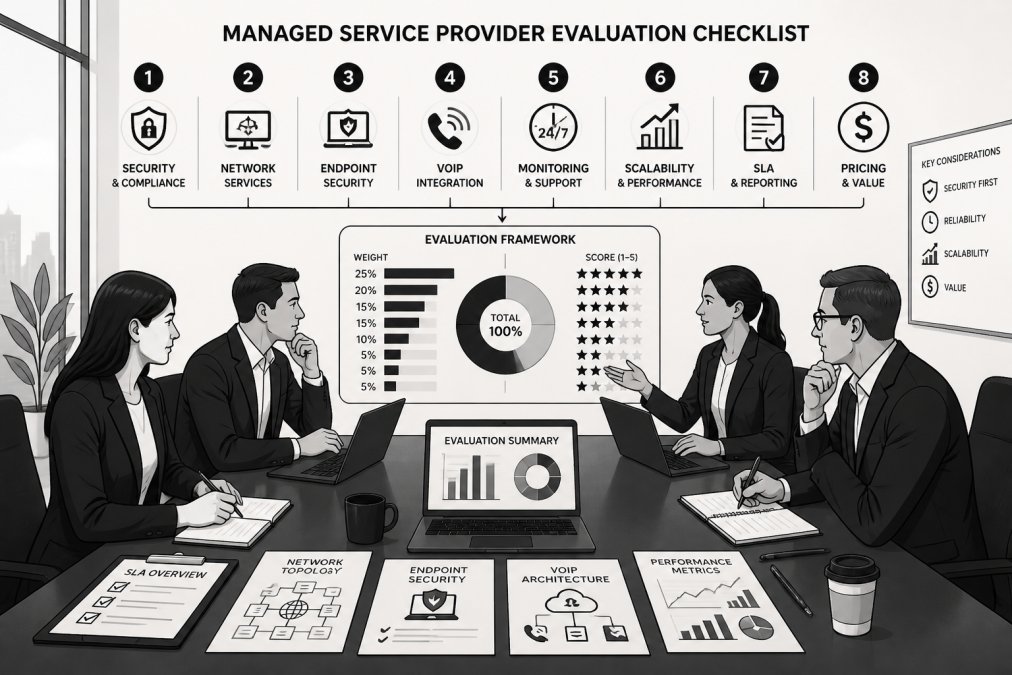
Technical Capabilities
- Supports your current systems and applications
- Has relevant industry certifications (Microsoft, AWS, security certs)
- Offers proactive monitoring with defined alert thresholds
- Provides endpoint detection and response (EDR)
- Includes 24/7 security operations center (SOC) monitoring
- Has documented incident response procedures
Service Quality
- Defines response time SLAs for critical issues (target: under 1 hour)
- Defines resolution time SLAs (target: 4-8 hours for critical)
- Offers unlimited helpdesk support
- Provides onboarding and implementation support
- Has documented change management procedures
- Offers regular reporting on system health and security
Industry Fit
- Has 3+ years experience in your specific industry
- Can provide references from similar-sized companies
- Understands your industry's compliance requirements
- Has handled similar technology environments
Security and Risk Management
- Holds SOC 2 Type II certification
- Provides security assessments or penetration testing results
- Has documented business continuity and disaster recovery plans
- Offers backup and disaster recovery with defined RTO/RPO
- Maintains cyber liability insurance
- Provides evidence of their own security practices
Business Terms
- Pricing is transparent with no hidden "out of scope" charges
- Contract terms are clear on what's included
- Exit clause allows 60+ days notice without penalty
- Data ownership is clearly defined
- Escalation procedures are documented
- Performance metrics are measurable and reported
Providers meeting 80%+ of these criteria are worth serious consideration.
Review MSP Contract Terms and Service-Level Agreements
Contract details separate good partnerships from painful ones.
Service-level agreements (SLAs) define what "managed" actually means. A provider promising "99.9% uptime" may exclude planned maintenance, customer-caused outages, and third-party failures. Real SLAs specify response times, resolution times, and coverage.
Understand exclusions. Many contracts exclude issues caused by your actions, third-party services, or "acts of God." A provider who excludes too much is transferring risk to you.
Understand contract length and exit terms. Can you leave with 30 days notice or are you locked in for three years? Will they cooperate with migration to another provider? A provider confident in their service welcomes easy exit.
Review pricing structure: per-user, per-device, per-month, or tiered? Are there setup fees? Ask about hidden costs upfront. VegaMSP's fully managed model aims to provide predictable IT costs.
Check renewal terms. Does pricing increase automatically? By how much? Can you renegotiate or are you stuck with whatever increase they impose?
Compare Managed IT Provider Pricing and Total Cost of Ownership
Pricing is rarely straightforward. Many providers quote low monthly rates but bury costs in setup fees, implementation charges, and "out of scope" services. Total cost of ownership (TCO) is what matters.
Build a cost comparison that includes all expenses over 24 months:
- Monthly management fees
- Setup and implementation costs
- Per-user or per-device charges if applicable
- Security tools or monitoring add-ons
- Backup and disaster recovery costs
- Any service minimums or commitments
- Contract termination or early exit fees
Compare this total across providers. A provider charging more per month but with lower setup costs and no hidden fees might be cheaper overall than one with a low headline rate.
Consider what you're replacing. If you're moving from break-fix support, calculate your current annual IT spending. Most organizations spend 15-20% of their technology budget on reactive support. Managed services shift this to predictable, proactive spending. The cost might be similar, but the outcome, fewer outages, better security, faster support, is dramatically different.
Factor in the value of eliminated downtime. If you experience one major outage per year costing $10,000 in lost productivity, and managed services prevent that, the ROI is immediate. If your IT team spends 30% of their time on routine maintenance, and managed services frees that time for strategic work, that's real value.
Ask for a proposal that breaks down all costs clearly. If a provider won't itemize their pricing, move on. Transparency matters.
Validate Security Posture and Request Evidence of Risk Management
Security claims are easy to make. Evidence is harder. Request proof before you commit.
Ask for SOC 2 Type II audit results. This independent audit verifies that a provider's security controls actually work. If they won't share it, they probably don't have it.
Request a security assessment of their infrastructure. How do they protect customer data? What encryption do they use? How are backups secured? How do they handle access controls?
Ask about their incident response process. If they detect a breach, what do they do? How quickly do they notify you? Do they have forensics capabilities?
Inquire about their own security vulnerabilities. Have they been breached? How did they respond? Do they participate in bug bounty programs? Do they conduct regular penetration testing?
Check their cyber liability insurance. This insurance covers costs if they cause a breach. The fact that they carry it signals they take security seriously. The coverage limits tell you their confidence level.
Ask about compliance certifications relevant to your industry. Healthcare requires HIPAA knowledge. Financial services requires SOC 2 and possibly PCI DSS understanding. Manufacturing might require NIST Cybersecurity Framework alignment.
Request a risk assessment specific to your environment. A good provider will identify your unique vulnerabilities and explain how their services mitigate them.
The process to evaluate managed IT service providers is a critical business decision. The right provider eliminates downtime, strengthens security, and frees your team to focus on growth.
Use this evaluation framework to move beyond marketing claims and sales pitches. Demand evidence. Require specificity. Get started with a consultation to see how managed services fit your specific environment.
Frequently Asked Questions
What should you look for in a managed IT service provider?
Prioritize providers with proven technical expertise, relevant industry experience, and transparent service-level agreements. Verify their cybersecurity capabilities, including endpoint detection and incident response. Check customer references and case studies to confirm they deliver measurable uptime and support quality. Evaluate their monitoring infrastructure, help desk responsiveness, and scalability to match your growth trajectory. Request evidence of their security operations center capabilities and risk management processes.
What questions should you ask a potential managed service provider?
Ask about response and resolution times for critical incidents, whether they offer 24/7 support, and how they handle onboarding without disrupting operations. Inquire about their security certifications, incident response procedures, and whether they conduct regular security audits. Request details on contract exit terms, scalability limits, and how pricing scales as your business grows. Ask for references from clients in your industry and examples of how they've handled migrations from other providers.
What should an MSP contract include?
A comprehensive MSP contract must specify service-level agreements with uptime guarantees, response times, and resolution times for different severity levels. Include clear definitions of what services are covered and what exclusions apply. Detail pricing structure, renewal terms, and how costs adjust if you scale up or down. Address data ownership, security standards, and compliance requirements relevant to your industry. Include exit clauses, transition assistance terms, and how long you have to migrate away if you decide to change providers.
How do you compare managed IT service providers?
Create a weighted evaluation scorecard that ranks providers across technical expertise, service scope, cybersecurity capabilities, support quality, and total cost of ownership. Request proposals from at least three providers using identical requirements so you can compare apples-to-apples. Review customer testimonials and case studies specific to your industry. Request pilot programs or trial periods to test their help desk responsiveness and monitoring effectiveness. Compare contract terms, SLA guarantees, and hidden costs before making your final decision.